Race · Sleds
Best Push Sleds (2026)Plate Fit, Surfaces and the Lane You Need
Prices checked November 11, 2026 · 10 min read
The best push sleds for a home gym are simple: a steel frame, a post or two for plates, and handles at a height that suits how you push. The hard part is not the sled, it is the floor. A sled needs a straight lane to travel along, and the surface under it decides whether the runners scrape, wear or leave marks. That is why this guide covers plate fit, handle layout and surface rules together.
Everything here comes from Amazon listings and manufacturer pages, not hands-on testing. Where a seller does not state a value (a warranty, a footprint, a plate sleeve size), the data tables say so rather than guess. Prices and stock are pulled from Amazon and shown on each card, so none are typed into the text.
The short version: the REP Fitness 4-Post Push-Pull Sled is the pick for a dedicated push and pull sled with a center post for plates, the REP Fitness Power Sled is the compact option, the Titan Fitness Pro Sled 750 LB is the one for heavy plate loads, the Titan Fitness High-Low Push-Pull Sled adds two push heights, the VEVOR Weight Sled is the budget pick that includes a harness, and the Torque Fitness TANK M1 Push Sled is for people who cannot use plates on a bare floor.
Quick picks
- $349.99Shop now →
- $199.99Shop now →
- $354.99Shop now →
Best for heavy loads
Titan Fitness Pro Sled 750 LB Weight Training Sled750 lb capacity and 40 x 24 in footprint per Titan.
- $250.99Shop now →
Best for adjustable push height
Titan Fitness High-Low Push-Pull SledHigh bar and low bar, 600 lb capacity per Titan.
- $132.90Shop now →
Best budget with harness
VEVOR Weight Sled Push-Pull Running SledPadded harness included, takes 1 in and 2 in plates.
- $749.00Shop now →
Best for floors that cannot take runners
Torque Fitness TANK M1 Push SledWheeled, with a magnetic brake instead of plates.
Some links on this page go to Amazon. As an Amazon Associate we earn from qualifying purchases, at no extra cost to you. Specifications come from each product's Amazon listing or manufacturer, not from our own testing; prices were checked on the date shown and change often. Affiliate disclosure
The picks
The 6 best push sleds for a home gym
Grouped by how you will actually use them: pushing on a lane with plates, pushing and pulling on a budget, or training on a floor you cannot scratch.

REP Fitness 4-Post Push-Pull Sled
REP states the REP Fitness 4-Post Push-Pull Sled is all steel including the underside, weighs 91.5 lb and measures 34.8 by 22 by 42 in. Two upright poles slot into any of four sockets, so you switch between high and low pushes, or reverse direction, without turning the sled around. The center post has 17 in of loadable length, equal to six 55 lb bumper plates per REP, and Amazon lists a 600 lb maximum. Straps and harness are not included, and the steel base is the one to think about on finished floors.
- Footprint
- 34.8 in x 22 in (88 cm x 56 cm)
- Ceiling
- No constraint
- Rated capacity
- 600 lb max load
- Warranty
- Not stated by the seller
Clearance: Needs a straight lane to push along. REP says the two upright poles move between four sockets so you change push direction without turning the sled around.

REP Fitness Power Sled
The REP Fitness Power Sled is listed at 33 by 35 by 23 in and 68 lb, with vertical push posts and an included tow point for harness work. The listing says it accepts Olympic weight plates, carries a 600 lb maximum recommendation, and is designed for turf, rubber gym flooring, grass or pavement. It has the shortest base of the plate-loaded sleds here, which helps in a small garage but means less leverage than the longer frames. The listing does not state a plate sleeve length.
- Footprint
- 33 in x 35 in (84 cm x 89 cm)
- Ceiling
- No constraint
- Rated capacity
- 600 lb max load
- Warranty
- Not stated by the seller
Clearance: Needs a straight lane to push along; the listing says it is designed for turf, rubber gym flooring, grass or pavement and has a compact footprint for storage.

Titan Fitness Pro Sled 750 LB Weight Training Sled
Titan lists the Titan Fitness Pro Sled Core Unit at 40 in deep, 24 in wide and 39 in tall, 102 lb, built from 2 x 3 in 11-gauge steel with a 750 lb weight capacity, the highest rating here. The 17 in weight sleeve is 48 mm, and two 37 in push poles go into four built-in sockets. Plastic ski liners protect the underside, and Titan says it suits turf, concrete and asphalt. Accessory bars such as a high bar attach through 2 in side holes but are sold separately. Titan lists a 1-year warranty.
- Footprint
- 40 in x 24 in (102 cm x 61 cm)
- Ceiling
- No constraint
- Rated capacity
- 750 lb max load
- Warranty
- 1 year
Clearance: Needs a straight lane to push along. Titan says the Pro Sled Core Unit works on turf, concrete, asphalt and other surfaces, and has four built-in pole sockets.
Titan Fitness High-Low Push-Pull Sled
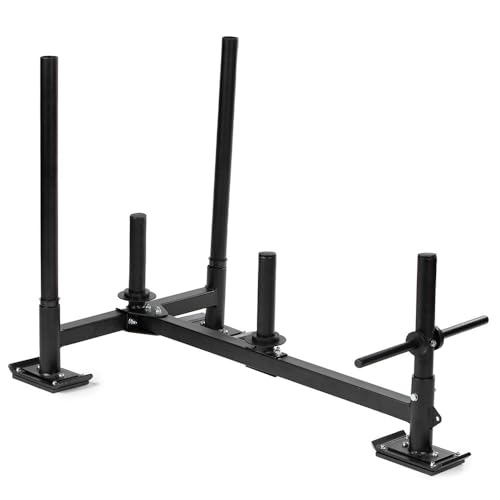
Titan publishes more numbers for the Titan Fitness High-Low Push-Pull Sled than most: 53 in long, 30.25 in wide, 64 lb, with two 9 in plate sleeves at 50 mm and a 600 lb capacity. Two 36 in poles give a high push, and a single 21 in low bar gives a driving position with 8.5 in grips. Titan says it works on grass, turf, concrete or asphalt, and plastic ski liners are optional. The sled is long, so check your lane first. Titan also says to load the rear first.
- Footprint
- 53 in x 30.3 in (135 cm x 77 cm)
- Ceiling
- No constraint
- Rated capacity
- 600 lb max load
- Warranty
- 1 year manufacturer
Clearance: Needs a straight lane to push along. Titan says it can be used on grass, turf, concrete or asphalt and breaks down for transport; plastic ski liners are optional.

VEVOR Weight Sled Push-Pull Running Sled
The VEVOR Weight Sled is listed at 40.55 by 25.98 in with a 276.6 lb load capacity, which is the lowest load rating here. It takes 1 in and 2 in plates, has push handles plus a low T-handle, and comes with a padded harness, so it is the one that works for both pushing and pulling out of the box. The listing describes it for turf, track or similar surfaces and says it disassembles for storage. Capacity and harness stitching suit moderate loads, not heavy ones.
- Footprint
- 40.5 in x 26 in (103 cm x 66 cm)
- Ceiling
- No constraint
- Rated capacity
- 276.6 lb max load
- Warranty
- Not stated by the seller
Clearance: Plate-loaded drag sled for turf, track or similar; disassembles for storage.

Torque Fitness TANK M1 Push Sled
The Torque Fitness TANK M1 Push Sled swaps plates for a Mag-Force magnetic brake and rolls on all-surface wheels, so it does not scrape the way a steel-ski sled can. The listing describes it as virtually silent and measures it at 45.1 by 31.9 in. The Torque Fitness TANK M3 Push Sled is the larger three-wheel version. The trade-off is that resistance is a brake setting, not a plate load, so you cannot match a specific plate weight to a race or a program.
- Footprint
- 45.1 in x 31.9 in (115 cm x 81 cm)
- Ceiling
- No constraint
- Rated capacity
- n/a
- Warranty
- 10-year frame and welds, 1-year parts
Clearance: Needs a run of floor to push along: a two-car garage or driveway rather than a spare room. Handles remove for storage.
Will it fit
Push sleds compared: footprint, lane and load
Footprint is sled length by width. The sled is only half the space: the lane you push or drag along is the real requirement.
- Footprint
- 34.8 in x 22 in (88 cm x 56 cm)
- Ceiling
- No constraint
- Capacity
- 600 lb max load
- Clearance
- Needs a straight lane to push along. REP says the two upright poles move between four sockets so you change push direction without turning the sled around.
- Footprint
- 33 in x 35 in (84 cm x 89 cm)
- Ceiling
- No constraint
- Capacity
- 600 lb max load
- Clearance
- Needs a straight lane to push along; the listing says it is designed for turf, rubber gym flooring, grass or pavement and has a compact footprint for storage.
- Footprint
- 40 in x 24 in (102 cm x 61 cm)
- Ceiling
- No constraint
- Capacity
- 750 lb max load
- Clearance
- Needs a straight lane to push along. Titan says the Pro Sled Core Unit works on turf, concrete, asphalt and other surfaces, and has four built-in pole sockets.
- Footprint
- 53 in x 30.3 in (135 cm x 77 cm)
- Ceiling
- No constraint
- Capacity
- 600 lb max load
- Clearance
- Needs a straight lane to push along. Titan says it can be used on grass, turf, concrete or asphalt and breaks down for transport; plastic ski liners are optional.
- Footprint
- 40.5 in x 26 in (103 cm x 66 cm)
- Ceiling
- No constraint
- Capacity
- 276.6 lb max load
- Clearance
- Plate-loaded drag sled for turf, track or similar; disassembles for storage.
- Footprint
- 45.1 in x 31.9 in (115 cm x 81 cm)
- Ceiling
- No constraint
- Capacity
- n/a
- Clearance
- Needs a run of floor to push along: a two-car garage or driveway rather than a spare room. Handles remove for storage.
| Product | Price | Footprint (L x W) | Ceiling | Clearance | Rated capacity |
|---|---|---|---|---|---|
| REP Fitness 4-Post Push-Pull Sled | $349.99 | 34.8 in x 22 in (88 cm x 56 cm) | No constraint | Needs a straight lane to push along. REP says the two upright poles move between four sockets so you change push direction without turning the sled around. | 600 lb max load |
| REP Fitness Power Sled | $199.99 | 33 in x 35 in (84 cm x 89 cm) | No constraint | Needs a straight lane to push along; the listing says it is designed for turf, rubber gym flooring, grass or pavement and has a compact footprint for storage. | 600 lb max load |
| Titan Fitness Pro Sled 750 LB Weight Training Sled | $354.99 | 40 in x 24 in (102 cm x 61 cm) | No constraint | Needs a straight lane to push along. Titan says the Pro Sled Core Unit works on turf, concrete, asphalt and other surfaces, and has four built-in pole sockets. | 750 lb max load |
| Titan Fitness High-Low Push-Pull Sled | $250.99 | 53 in x 30.3 in (135 cm x 77 cm) | No constraint | Needs a straight lane to push along. Titan says it can be used on grass, turf, concrete or asphalt and breaks down for transport; plastic ski liners are optional. | 600 lb max load |
| VEVOR Weight Sled Push-Pull Running Sled | $132.90 | 40.5 in x 26 in (103 cm x 66 cm) | No constraint | Plate-loaded drag sled for turf, track or similar; disassembles for storage. | 276.6 lb max load |
| Torque Fitness TANK M1 Push Sled | $749.00 | 45.1 in x 31.9 in (115 cm x 81 cm) | No constraint | Needs a run of floor to push along: a two-car garage or driveway rather than a spare room. Handles remove for storage. | n/a |
Ceiling height does not apply to floor equipment. Rated capacity is the maximum plate load where the listing or manufacturer states one.
How to choose a push sled
Match the sled to the way you will train. For conditioning pushes you want handles and a stable base. A harness-and-strap sled such as the VEVOR Weight Sled suits sprint drags and backward pulls, while the poles on the plate-loaded Titan and REP sleds suit pushing. If your goal is training for a fitness race at home, the push is the movement to copy, so choose a sled with poles and add a strap for pulls.
Check the plate sleeve and what fits it. An Olympic plate has a 2 in (50 mm) bore, and Titan lists 50 mm sleeves on the High-Low and 48 mm on the Pro Sled. REP states Olympic plate compatibility on its pages, and the VEVOR listing also covers 1 in plates. Sleeve length decides how many plates fit: Titan lists 9 in sleeves on the High-Low and 17 in on the Pro Sled (48 mm), while REP gives 17 in on the 4-Post center post. Bumper plates are thick, so a short sleeve loads fewer of them.
Think about handle height and count. Two high poles keep you upright for sprint-style pushing. A low bar or low socket puts the hips down and drives the quads. The Titan High-Low offers both on one frame, the REP 4-Post and Titan Pro Sled let you move the poles between sockets, and the REP Power Sled has fixed vertical posts. Single-handle sleds suit pulling, not pushing.
Read the base and runners. A longer base is steadier under load but needs a longer lane; a shorter base digs in more under light loads, as some REP reviewers note on REP's page. Steel skis are the cheapest, loudest and hardest on floors. Plastic ski liners (Titan fits them on the Pro Sled and calls them optional on the High-Low) protect the surface and the steel, but wear down and can be replaced.
Count what is included. Straps and harnesses are often extras. The VEVOR includes a padded harness, Titan lists two poles with the Pro Sled but no harness, and REP says straps and harness are not included with its push-pull sleds. Budget for a belt or harness before you compare sticker prices.
Surfaces
Push sled surfaces: turf, concrete and rubber
Only what each seller or manufacturer says. None of these listings publish a runner wear rate, so replacement is a judgment call.
| Sled | Surfaces the seller names | Runner note |
|---|---|---|
| REP Fitness 4-Post Push-Pull Sled | Not stated on REP's page | Steel underside per REP |
| Titan Fitness High-Low Push-Pull Sled | Grass, turf, concrete, asphalt | Plastic ski liners optional |
| REP Fitness Power Sled | Turf, rubber gym flooring, grass, pavement | Not stated |
| Titan Fitness Pro Sled 750 LB | Turf, concrete, asphalt and other surfaces per Titan | Plastic ski liners fitted |
| VEVOR Weight Sled | Turf, track or similar | Not stated |
| Torque Fitness TANK M1 Push Sled | All surfaces, per the listing | Wheeled, no skis |
A steel base on concrete is loud and abrasive, and rubber flooring can mark or tear under a loaded steel ski. Our flooring guide covers what to put down before you load a sled.
Space
How much lane does a push sled need?
The sled footprint is small, between about 33 and 53 in long among the plate-loaded sleds here. The lane is what takes space: add the push distance you want, the sled's own length and a few feet at each end to stop and turn. The listings do not give a required lane length, so measure your garage, driveway or yard before buying. Our space planning guide has a method for measuring a lane, and the fitness-race home gym guide covers where a sled fits alongside the other stations.
Race organizers set their own sled weights and surfaces, and they do not publish a sled you can buy and call equivalent. Treat any home sled as practice for the movement, not as an exact copy of an event sled. No sled here is sold as event-approved or affiliated with any race.
Pushing is not the only use. Strapping a sled to a harness gives drags, and loading it lightly for sprint intervals is a common use per the listings. If you already run a rack-based home gym, a sled shares your plates, which is why plate compatibility matters more than it first appears.
Set-up checklist
Before your first push
- 1
Measure the lane
Walk the lane, add the sled length and stopping room, and clear anything on the floor that could catch a runner.
- 2
Check the plate bore
Confirm your plates fit the sleeve. A 2 in Olympic plate needs a 50 mm sleeve; some sleds also take 1 in plates.
- 3
Load rear first
Titan says to load the rear of its High-Low sled first and never make the front heavier. Follow the manufacturer's loading note for any sled.
- 4
Add a strap or belt
If you want pulls, buy a harness or belt. REP says straps and harness are not included with its push-pull sleds.
- 5
Protect the floor
Use plastic ski liners where offered, or a mat the manufacturer names as suitable, before pushing on a finished surface.
FAQ
What is the best weight sled for a home gym?
For most people, a steel plate-loaded sled with removable push poles, such as the REP Fitness 4-Post Push-Pull Sled or the Titan Fitness Pro Sled 750 LB. They use your existing plates and store apart. If you only have a bare floor, the wheeled Torque Fitness TANK M1 Push Sled avoids steel runners.
Do push sleds fit Olympic plates?
Most plate-loaded sleds do. Titan lists 50 mm sleeves on its sleds, which is the Olympic 2 in bore, and REP states Olympic compatibility for its push-pull sleds. The VEVOR also takes 1 in plates. Check the listing for the sleeve length, because it limits how many plates fit.
Can I use a push sled on concrete?
Titan says its High-Low sled can be used on concrete, and REP lists pavement for its Power Sled. Bare steel skis are loud and wear, so plastic ski liners help. Some sleds are made for turf and track, so check the seller's surface notes before pushing on concrete.
Do I need turf for a push sled?
Not always. Several listings name concrete, pavement or rubber flooring as suitable, and wheeled sleds like the Torque Fitness TANK M1 skip runners altogether. Turf is gentler on steel and quieter, but the manufacturer's stated surface list is what matters.
How much space do I need for a push sled?
The sled footprints here run from about 33 by 35 in to 53 by 30.25 in, but the lane matters more. Add your push distance, the sled length and stopping room. Sellers do not publish a required lane length, so measure your space and use our space guide.
Do push sleds come with straps or a harness?
It varies. The VEVOR includes a padded harness, the Titan Pro Sled lists poles but no harness, and REP says straps and harness are not included with its push-pull sleds. A belt for pulls is often a separate purchase.