Planning · Flooring
Best Home Gym Flooring (2026)Stall Mats, Rubber Rolls and Tiles, by Thickness and Use
Prices checked November 11, 2026 · 11 min read
The best home gym flooring is the one matched to the heaviest thing you will do on it. A garage deadlift platform, a treadmill in a spare room and a yoga corner need different products, and the wrong choice shows up as dented concrete, a shifting mat or a floor that compresses under a rack. The six options below cover the four main formats: solid rubber stall mats, rolled rubber, interlocking rubber tiles and foam tiles.
Every figure here comes from the Amazon listing and the manufacturer's own pages and spec sheets, not from hands-on testing. Where a manufacturer does not state something (weight per mat, warranty terms, odor), we say so rather than guess. None of these brands publishes a weight-drop rating, so the thickness guidance below is reasoning from the stated thickness and use, not a certified limit. Prices are not typed into this article; they appear on the cards and tables from our regular Amazon price checks.
The short version: the American Floor Mats Heavy Duty Stall Mat 3/4 in is the pick for deadlifts and dropped weights, the American Floor Mats Fit-Lock 3/8 in tiles suit anyone who wants interlocking rubber with no adhesive, the Rubber-Cal Elephant Bark 3/16 in roll is the light option for cardio machines and general floor protection, and the ProsourceFit 3/4 in foam puzzle mat is the comfortable choice for floor work and stretching, not for heavy lifting.
Quick picks
- $232.74Shop now →
Best for deadlifts
American Floor Mats Heavy Duty Stall Mat 3/4 in, 4 x 6 ft3/4 in solid rubber, 24 sq ft per mat.
- $201.50Shop now →
Best middle thickness
American Floor Mats Heavy Duty Stall Mat 1/2 in, 4 x 6 ftSame 4 x 6 ft mat at 1/2 in.
- $128.60Shop now →
Best interlocking tiles
American Floor Mats Fit-Lock 3/8 in Interlocking Rubber Tiles, 4 x 6 ft Set3/8 in rubber, no adhesive needed.
- $71.42Shop now →
Best rolled rubber
Rubber-Cal Elephant Bark Rubber Flooring 3/16 in, 4 x 8 ft Black Roll CutRecycled rubber, 60 Shore A, 4 x 8 ft cut.
- $49.99Shop now →
Best for floor work
ProsourceFit Weaved Exercise Puzzle Mat 3/4 in, 24 sq ft, 6 Tiles3/4 in EVA foam tiles with borders.
- $22.62Shop now →
Some links on this page go to Amazon. As an Amazon Associate we earn from qualifying purchases, at no extra cost to you. Specifications come from each product's Amazon listing or manufacturer, not from our own testing; prices were checked on the date shown and change often. Affiliate disclosure
The picks
The 6 best home gym flooring options
Ordered from the heaviest-duty rubber to the lightest floor protection. Check the thickness first, then the format.

American Floor Mats Heavy Duty Stall Mat 3/4 in, 4 x 6 ft
This is a 3/4 in thick, 4 x 6 ft solid rubber mat from American Floor Mats, one of its horse stall mats that the company's cut sheet says is designed to hold heavy weight. The manufacturer states it is made in the US from US-sourced raw materials with no fillers, but does not say whether the rubber is virgin or recycled, and it does not state weight per mat, warranty terms or odor. Individual straight-edge mats leave seams, so expect to butt them together.
- Footprint
- 72 in x 48 in (183 cm x 122 cm)
- Ceiling
- No constraint
- Rated capacity
- n/a
- Warranty
- Not stated by the seller
Clearance: Each mat covers 24 sq ft (4 x 6 ft). An 8 x 10 ft area (80 sq ft) needs 80 / 24 = 3.3, so 4 mats. A 20 x 20 ft two-car garage (400 sq ft) needs 400 / 24 = 16.7, so 17 mats.
American Floor Mats Heavy Duty Stall Mat 1/2 in, 4 x 6 ft
The same 4 x 6 ft solid mat at 1/2 in thick, from the family that American Floor Mats sells in 3/8, 1/2 and 3/4 in. It covers the same 24 sq ft per mat as the thicker version, so the choice is about how hard the floor will be hit. For racks, benches and machines with occasional dropped dumbbells it is a reasonable middle step. For regular barbell deadlifts, the 3/4 in version above is the more cautious choice. Weight and warranty terms are not stated.
- Footprint
- 72 in x 48 in (183 cm x 122 cm)
- Ceiling
- No constraint
- Rated capacity
- n/a
- Warranty
- Not stated by the seller
Clearance: Each mat covers 24 sq ft (4 x 6 ft). An 8 x 10 ft area (80 sq ft) needs 80 / 24 = 3.3, so 4 mats. A 20 x 20 ft two-car garage (400 sq ft) needs 400 / 24 = 16.7, so 17 mats.
American Floor Mats Fit-Lock 3/8 in Interlocking Rubber Tiles, 4 x 6 ft Set
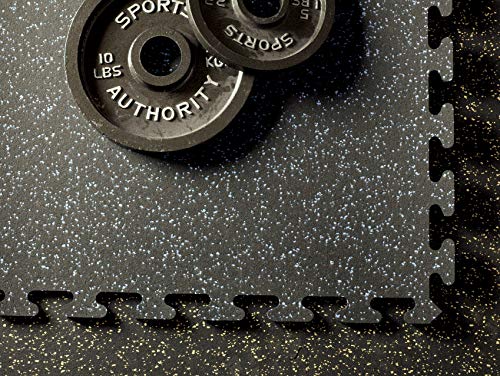
American Floor Mats Fit-Lock tiles are 3/8 in (9.5 mm) all-rubber, 2 x 2 ft, and lock together with no adhesive. The manufacturer says they weigh about 2 lb per sq ft (roughly 8 lb a tile), do not off-gas and are FloorScore certified for low VOC emissions. This set holds 4 corner and 2 border tiles for 24 sq ft, so the edges are finished. The manufacturer says they hold up to rolled machines like treadmills and heavy racks, but gives no weight-drop rating.
- Footprint
- 72 in x 48 in (183 cm x 122 cm)
- Ceiling
- No constraint
- Rated capacity
- n/a
- Warranty
- Not stated by the seller
Clearance: Each tile is 2 x 2 ft (4 sq ft), so a 6-tile set covers 24 sq ft. An 8 x 10 ft area (80 sq ft) needs 80 / 24 = 3.3, so 4 sets. A 20 x 20 ft two-car garage (400 sq ft) needs 400 / 24 = 16.7, so 17 sets. Leave about 1/2 in around the perimeter (per the manufacturer).
Rubber-Cal Elephant Bark Rubber Flooring 3/16 in, 4 x 8 ft Black Roll Cut
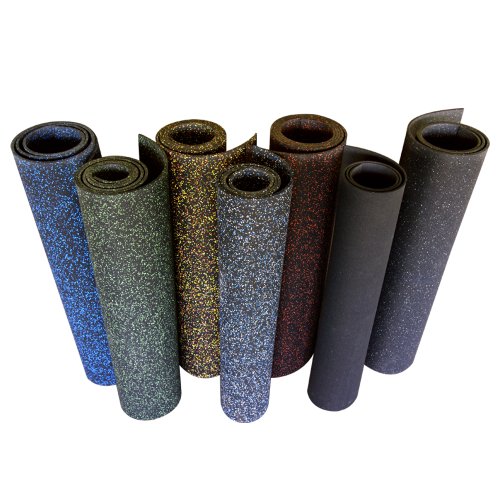
Rubber-Cal's spec sheet describes Elephant Bark as 83% post-consumer recycled rubber with a high EPDM content, 5 mm thick (a hint over 3/16 in), 0.97 lb per sq ft and 60 Shore A nominal. This 4 x 8 ft cut is the thinnest rubber here, suited to treadmills, bikes and light free weights rather than dropped barbells. Rubber-Cal suggests double-sided carpet tape for temporary installs and Chemrex CX-941 adhesive for permanent ones. It states no warranty or odor claim.
- Footprint
- 96 in x 48 in (244 cm x 122 cm)
- Ceiling
- No constraint
- Rated capacity
- n/a
- Warranty
- Not stated by the seller
Clearance: This 4 x 8 ft cut covers 32 sq ft. An 8 x 10 ft area (80 sq ft) needs 80 / 32 = 2.5, so 3 cuts. A 20 x 20 ft two-car garage (400 sq ft) needs 400 / 32 = 12.5, so 13 cuts.

ProsourceFit Weaved Exercise Puzzle Mat 3/4 in, 24 sq ft, 6 Tiles
The ProsourceFit puzzle mat is not rubber. It is high-density EVA foam, six 24 x 24 x 3/4 in tiles with 12 end borders covering 24 sq ft, with a stated total weight of 7.63 lb. That softness suits stretching, yoga, bodyweight and mobility work. ProsourceFit says it can withstand heavy exercise equipment and points to its 1 in mat for ultra-heavy equipment; the listing itself warns that surface compression may occur. Keep it away from barbells.
- Footprint
- 72 in x 48 in (183 cm x 122 cm)
- Ceiling
- No constraint
- Rated capacity
- n/a
- Warranty
- Not stated by the seller
Clearance: Each set holds six 2 x 2 ft tiles, so it covers 24 sq ft. An 8 x 10 ft area (80 sq ft) needs 80 / 24 = 3.3, so 4 sets. A 20 x 20 ft two-car garage (400 sq ft) needs 400 / 24 = 16.7, so 17 sets.

XTERRA Fitness 6mm PVC Equipment Floor Mat, 3 x 4 ft
The XTERRA Fitness equipment mat is a 3 x 4 ft sheet of 6 mm PVC that the manufacturer sizes for most upright bikes and says reduces noise and vibration and protects floors from scratches and dings. At 12 sq ft it is a per-machine mat, not whole-room flooring. A treadmill or rower is longer than 4 ft, and the manufacturer page does not give a treadmill-size version, so measure the machine before buying. Weight and warranty are not stated.
- Footprint
- 48 in x 36 in (122 cm x 91 cm)
- Ceiling
- No constraint
- Rated capacity
- n/a
- Warranty
- Not stated by the seller
Clearance: Each mat covers 12 sq ft (3 x 4 ft) and is sized for one bike-size machine (per the manufacturer), not for blanket coverage. An 8 x 10 ft area (80 sq ft) would need 80 / 12 = 6.7, so 7 mats; a 20 x 20 ft garage would need 400 / 12 = 33.3, so 34 mats.
Coverage
Flooring compared: size, coverage and what each unit covers
Footprint is one unit as sold (one mat, one tile set or one roll cut). The clearance column shows how many units cover an 8 x 10 ft area and a 20 x 20 ft two-car garage.
- Footprint
- 72 in x 48 in (183 cm x 122 cm)
- Ceiling
- No constraint
- Capacity
- n/a
- Clearance
- Each mat covers 24 sq ft (4 x 6 ft). An 8 x 10 ft area (80 sq ft) needs 80 / 24 = 3.3, so 4 mats. A 20 x 20 ft two-car garage (400 sq ft) needs 400 / 24 = 16.7, so 17 mats.
- Footprint
- 72 in x 48 in (183 cm x 122 cm)
- Ceiling
- No constraint
- Capacity
- n/a
- Clearance
- Each mat covers 24 sq ft (4 x 6 ft). An 8 x 10 ft area (80 sq ft) needs 80 / 24 = 3.3, so 4 mats. A 20 x 20 ft two-car garage (400 sq ft) needs 400 / 24 = 16.7, so 17 mats.
- Footprint
- 72 in x 48 in (183 cm x 122 cm)
- Ceiling
- No constraint
- Capacity
- n/a
- Clearance
- Each tile is 2 x 2 ft (4 sq ft), so a 6-tile set covers 24 sq ft. An 8 x 10 ft area (80 sq ft) needs 80 / 24 = 3.3, so 4 sets. A 20 x 20 ft two-car garage (400 sq ft) needs 400 / 24 = 16.7, so 17 sets. Leave about 1/2 in around the perimeter (per the manufacturer).
- Footprint
- 96 in x 48 in (244 cm x 122 cm)
- Ceiling
- No constraint
- Capacity
- n/a
- Clearance
- This 4 x 8 ft cut covers 32 sq ft. An 8 x 10 ft area (80 sq ft) needs 80 / 32 = 2.5, so 3 cuts. A 20 x 20 ft two-car garage (400 sq ft) needs 400 / 32 = 12.5, so 13 cuts.
- Footprint
- 72 in x 48 in (183 cm x 122 cm)
- Ceiling
- No constraint
- Capacity
- n/a
- Clearance
- Each set holds six 2 x 2 ft tiles, so it covers 24 sq ft. An 8 x 10 ft area (80 sq ft) needs 80 / 24 = 3.3, so 4 sets. A 20 x 20 ft two-car garage (400 sq ft) needs 400 / 24 = 16.7, so 17 sets.
- Footprint
- 48 in x 36 in (122 cm x 91 cm)
- Ceiling
- No constraint
- Capacity
- n/a
- Clearance
- Each mat covers 12 sq ft (3 x 4 ft) and is sized for one bike-size machine (per the manufacturer), not for blanket coverage. An 8 x 10 ft area (80 sq ft) would need 80 / 12 = 6.7, so 7 mats; a 20 x 20 ft garage would need 400 / 12 = 33.3, so 34 mats.
| Product | Price | Footprint (L x W) | Ceiling | Clearance | Rated capacity |
|---|---|---|---|---|---|
| American Floor Mats Heavy Duty Stall Mat 3/4 in, 4 x 6 ft | $232.74 | 72 in x 48 in (183 cm x 122 cm) | No constraint | Each mat covers 24 sq ft (4 x 6 ft). An 8 x 10 ft area (80 sq ft) needs 80 / 24 = 3.3, so 4 mats. A 20 x 20 ft two-car garage (400 sq ft) needs 400 / 24 = 16.7, so 17 mats. | n/a |
| American Floor Mats Heavy Duty Stall Mat 1/2 in, 4 x 6 ft | $201.50 | 72 in x 48 in (183 cm x 122 cm) | No constraint | Each mat covers 24 sq ft (4 x 6 ft). An 8 x 10 ft area (80 sq ft) needs 80 / 24 = 3.3, so 4 mats. A 20 x 20 ft two-car garage (400 sq ft) needs 400 / 24 = 16.7, so 17 mats. | n/a |
| American Floor Mats Fit-Lock 3/8 in Interlocking Rubber Tiles, 4 x 6 ft Set | $128.60 | 72 in x 48 in (183 cm x 122 cm) | No constraint | Each tile is 2 x 2 ft (4 sq ft), so a 6-tile set covers 24 sq ft. An 8 x 10 ft area (80 sq ft) needs 80 / 24 = 3.3, so 4 sets. A 20 x 20 ft two-car garage (400 sq ft) needs 400 / 24 = 16.7, so 17 sets. Leave about 1/2 in around the perimeter (per the manufacturer). | n/a |
| Rubber-Cal Elephant Bark Rubber Flooring 3/16 in, 4 x 8 ft Black Roll Cut | $71.42 | 96 in x 48 in (244 cm x 122 cm) | No constraint | This 4 x 8 ft cut covers 32 sq ft. An 8 x 10 ft area (80 sq ft) needs 80 / 32 = 2.5, so 3 cuts. A 20 x 20 ft two-car garage (400 sq ft) needs 400 / 32 = 12.5, so 13 cuts. | n/a |
| ProsourceFit Weaved Exercise Puzzle Mat 3/4 in, 24 sq ft, 6 Tiles | $49.99 | 72 in x 48 in (183 cm x 122 cm) | No constraint | Each set holds six 2 x 2 ft tiles, so it covers 24 sq ft. An 8 x 10 ft area (80 sq ft) needs 80 / 24 = 3.3, so 4 sets. A 20 x 20 ft two-car garage (400 sq ft) needs 400 / 24 = 16.7, so 17 sets. | n/a |
| XTERRA Fitness 6mm PVC Equipment Floor Mat, 3 x 4 ft | $22.62 | 48 in x 36 in (122 cm x 91 cm) | No constraint | Each mat covers 12 sq ft (3 x 4 ft) and is sized for one bike-size machine (per the manufacturer), not for blanket coverage. An 8 x 10 ft area (80 sq ft) would need 80 / 12 = 6.7, so 7 mats; a 20 x 20 ft garage would need 400 / 12 = 33.3, so 34 mats. | n/a |
Flooring has no ceiling requirement and no load rating. The 20 x 20 ft garage is an example size; measure your own floor.
Thickness
Gym flooring thickness: which one for which job
Thicknesses are as stated by each manufacturer. The 'suits' column is our reading of the stated use, not a rating.
| Product | Stated thickness | Material | Suits |
|---|---|---|---|
| American Floor Mats Heavy Duty Stall Mat 3/4 in | 3/4 in | Solid rubber | Barbell deadlifts, racks, dropped weights |
| American Floor Mats Heavy Duty Stall Mat 1/2 in | 1/2 in | Solid rubber | Racks, benches, machines, dropped dumbbells |
| American Floor Mats Fit-Lock | 3/8 in (9.5 mm) | Interlocking rubber | Mixed gym use, treadmills, light to moderate lifting |
| Rubber-Cal Elephant Bark | 5 mm (just over 3/16 in) | Recycled rubber, EPDM | Cardio machines, sled or floor protection, light weights |
| ProsourceFit puzzle mat | 3/4 in | EVA foam | Yoga, stretching, bodyweight work |
| XTERRA equipment mat | 6 mm | PVC | A single bike or small machine |
Manufacturers on these pages do not publish a weight-drop rating. Treat thickness as a proxy and check the subfloor too.
How to choose
How to choose rubber flooring for a home gym
Start with the heaviest thing you will do. If you deadlift or drop loaded barbells, a thick solid rubber mat is the sensible baseline, and the 3/4 in stall mat is the thickest rubber on this list. If your heaviest load is a rack, a bench and adjustable dumbbells, thinner rubber will protect the floor from equipment feet and noise. If it is a treadmill and bodyweight work, thin rolled rubber or a machine mat is usually enough.
Horse stall mats for gym use are popular because they are thick, durable and sold by the mat at a lower cost per square foot than purpose-made gym tiles. The trade-offs are weight, seams and smell. American Floor Mats says its stall mats are made in the US with no fillers but does not state weight per mat or odor on the pages we read, so plan for two people to move them and for airing them out. For the full picture of a power rack on top, see our guide to the best power racks for home gym use.
Material matters too. Rubber-Cal states Elephant Bark is 83% post-consumer recycled rubber with a high EPDM content, rated 60 Shore A. American Floor Mats does not say whether its stall mats are virgin or recycled. Hardness figures are only useful if the maker states them, so where a page is silent we have left it blank rather than infer.
Formats
Interlocking gym tiles, rolls, stall mats and foam
Each format trades seams, install effort and thickness differently.
Solid stall mats
Thick, individual mats such as the 4 x 6 ft AFM options. They stay put under their own weight and suit lifting, but leave visible seams and are heavy to move.
Rolled rubber
Rubber-Cal Elephant Bark comes in 48 in wide rolls and cuts to length. Thin, cuttable and flat, with tape or adhesive for fixing it. Best for cardio and light use.
Interlocking rubber tiles
Fit-Lock 2 x 2 ft tiles lock together with no adhesive and have finished border and corner pieces. Good for odd-shaped rooms; seams are tight but present.
Foam tiles
EVA foam such as the ProsourceFit set is light and soft. It is the right surface for stretching and mobility, and the wrong one under a rack or a barbell.
Cardio and sleds
Flooring for a treadmill, rower and sled
A treadmill or rower is long, so a 3 x 4 ft mat covers only part of it. For a treadmill the useful measure is the machine's footprint plus a little extra around it; our best curved treadmills and best rowing machines guides give footprints, and the best push sleds guide covers sled setups. A rolled rubber cut or a few interlocking tiles usually cover that better than a small machine mat.
For sled pushing, flooring that is flat, anchored and low-friction in the right places is the goal, and no manufacturer here states sled suitability, so treat that as an open question. The same goes for dragging heavy machines: American Floor Mats says glue or tape may be needed on thick carpet or where heavy objects are dragged across the Fit-Lock tiles.
Measure
How much flooring do I need? A worked example
Work in square feet, then divide by the area one unit covers. The example below is a 10 x 12 ft room with a 3 x 4 ft bike mat.
- 1
1. Measure the area
Length times width. A 10 x 12 ft room is 10 x 12 = 120 sq ft. Measure only the area you will cover; a lifting platform might be 8 x 8 ft = 64 sq ft.
- 2
2. Find the coverage per unit
A 4 x 6 ft mat is 4 x 6 = 24 sq ft. A Fit-Lock tile is 2 x 2 = 4 sq ft, so six tiles are 24 sq ft. The Rubber-Cal 4 x 8 ft cut is 32 sq ft.
- 3
3. Divide and round up
For a 64 sq ft platform with 24 sq ft mats: 64 / 24 = 2.7, so 3 mats. For the full 120 sq ft room: 120 / 24 = 5, so 5 mats.
- 4
4. Add for cuts and borders
Mats and rolls waste material around walls and obstacles. Add a spare mat or a few tiles, or lay out the room on paper first. Leave about 1/2 in at the walls with Fit-Lock tiles (per the manufacturer).
- 5
5. Check the subfloor and the door
Add up what the floor carries and measure the doorway the mats must pass through. Mats are heavy and often arrive in packs; check how your garage or room is accessed.
Will it fit
Garage gym flooring: subfloor, moisture and protecting the floor from weights
To protect a floor from weights, cover the actual landing zone and thicken it where plates land. Our home gym space guide covers how much room each station needs, and thickness adds height at the edges, so check the home gym ceiling height guide if overhead presses are close to the limit.
Concrete garage floors can trap moisture under any mat. None of the listings or manufacturer pages here give moisture or vapor guidance, so lift a corner now and then and check. Rubber-Cal states Elephant Bark suits outdoor use because of its EPDM content, while the foam set is described as water-resistant but is not described for damp floors.
On an upstairs or wooden floor, rubber also reduces noise and vibration, but none of these brands state a decibel or sound-transmission figure, so we avoid quoting one. If noise matters, thicker rubber is the likelier choice, but that is our reasoning, not a stated figure.
FAQ
What is the best flooring for a home gym?
It depends on the heaviest thing you do. For deadlifts and racks, thick solid rubber such as the 3/4 in American Floor Mats stall mat is the heavy-duty option here. For cardio and general protection, thinner rolled rubber or interlocking tiles work. Foam suits only floor work. None of the manufacturers publish a drop rating, so match thickness to your heaviest load.
Are horse stall mats good for a home gym?
Many people use them because they are thick and sold as individual 4 x 6 ft mats. American Floor Mats sells 4 x 6 ft stall mats in 3/8, 1/2 and 3/4 in and says they are made in the US with no fillers. The pages do not state weight per mat or odor, so expect heavy mats, visible seams and a possible smell to air out.
How thick should garage gym flooring be?
Thicker is safer for dropped weights, and the 3/4 in stall mat is the thickest rubber we cover. A 3/8 in tile or 1/2 in mat protects a floor from racks, benches and machines. Thin rubber around 5 mm, such as Rubber-Cal Elephant Bark, suits cardio. No brand here publishes a weight-drop rating, so this is our reading, not a certified limit.
What flooring do I need for a treadmill or rower?
A treadmill and a rower are both longer than the 3 x 4 ft XTERRA mat, which the manufacturer sizes for bikes. Measure the machine, then use a rubber roll cut to length, a stall mat or interlocking tiles. Thin rubber is usually enough for cardio, because the load is steady rather than dropped.
Are interlocking gym tiles worth it?
They suit odd-shaped rooms and renters. American Floor Mats says its Fit-Lock tiles need no adhesive and come with border and corner pieces in the set. They are thinner than stall mats at 3/8 in, so they are better for general gym use than for heavy, repeated dropped barbells. Foam tiles are softer still and are not designed for heavy lifting.
Does rubber flooring smell, and does it need adhesive?
Odor claims vary by maker. American Floor Mats says Fit-Lock tiles will not off-gas and are FloorScore certified; its stall mat pages make no odor claim, and Rubber-Cal's spec sheet makes none. Adhesive is optional: Fit-Lock needs none, and Rubber-Cal suggests tape for temporary and Chemrex CX-941 adhesive for permanent installs.